GFV ALSACE
Why Invest in a Wine Land Group (GFV) in Alsace ?
Alsace Wine Land Group (GFV) in progress
 From €4,500
AOC Alsace
- Since 1820
- Distribution in kind: 12 Bottles
- Non-guaranteed return above +4.6% marketing fees included
Return and capital not guaranteed. The winegrower may be unable to pay you in the event of a poor harvest.
If you do not have the several million euros needed to buy an entire wine estate, or the technical know-how to manage an estate directly, it is worthwhile to invest in a GFV Alsace.

CONTENTS
- How a GFV Alsace works?
- Reasons to invest in a GFV in the Alsace region.
- Taxation of the GFV Alsace.
- Overview of the GFVs of the Eastern Region.

How a Wine Land Group (GFV) in Alsace works
This is a non-operating agricultural land group whose objective is the collective ownership of a wine estate in the Alsace region.
A legal entity is created in order to buy the vineyard. The vineyard is then leased through a long-term lease to an experienced winegrower.
More simply, it is a small number of individuals (private savers) who invest together to buy an estate and manage it collectively through a Management Company. The latter is appointed for all unit holders since it set up the entire GFV Alsace.
Why invest in a vineyard located in Alsace?
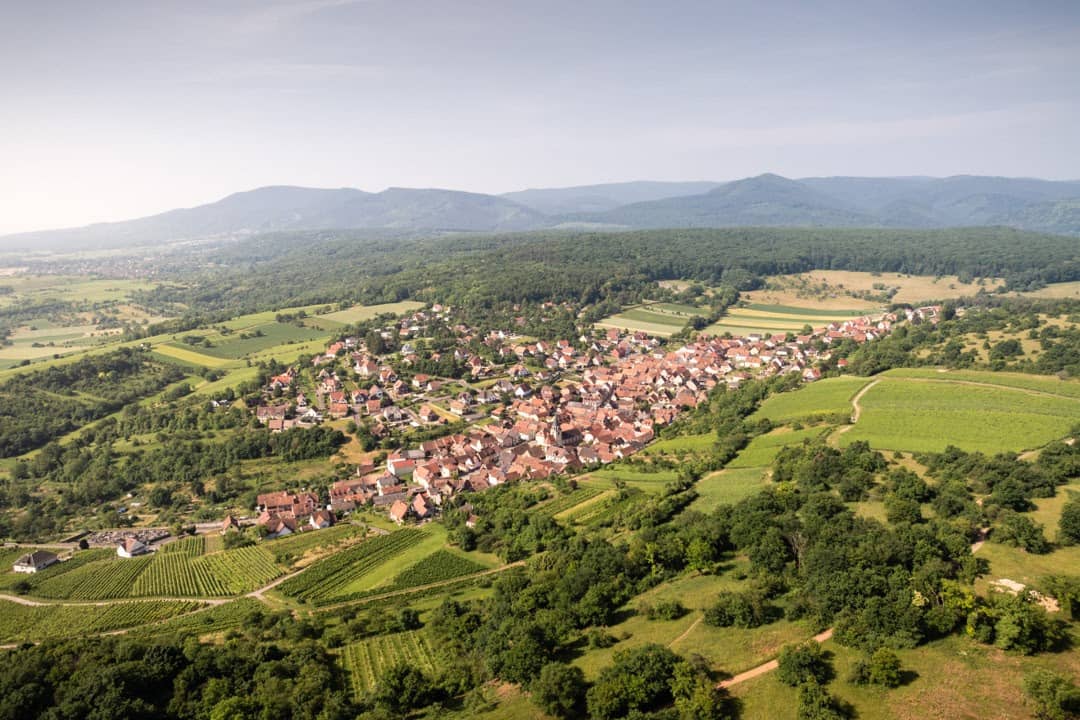
The Alsatian vineyard spans about 15,621 hectares spread over 120 km in length. One hundred and nineteen municipalities have vines located between 170 and 550 m in altitude.
One of the oldest wine routes in France winds through the vineyard: the Alsace Wine Route, inaugurated in 1953, which crosses 170 wine-growing villages over a long route of 170 km.
Wine production in Alsace reached 907,269 hectolitres. That is nearly 120,970,000 bottles. At that time Alsace had 3,908 declared producers. The Alsace region made a name for itself thanks to its wines that are powerful in terms of alcohol, aromas and sugar.
The vines in Alsace benefit from maximum sunshine and unique terroirs. The overall Alsatian production is sold 74% in France, with the remaining 26% going to export. The most important importers include Belgium, Germany, the United States and Sweden. Alsace is a region renowned region whose wines in the Middle Ages were already among the most prestigious on the European continent.

GFV shares for sale
Discover the list of our wine estates currently being marketed
Taxation of the Alsatian GFV
At first glance, the idea of making a long-term investment in a wine estate in order to obtain profits may seem unclear to you. Des tax benefits really arise from it?
Indeed, the winegrower will pay the various unit holders of the Alsace Wine Land Group (GFV) thanks to income from the lease (fermage). This income can be paid either in cash (cash to the partners) or in kind, i.e. in bottles of wine from the Estate.
When dividends are paid in the form of bottles of wine, the return is improved insofar as the partner receives bottles valued at a production price well below the price at which they will be marketed. This type of investment is intended for people who wish to invest in a tangible, rare, prestigious asset, for people who are passionate about wine, and also for people who have wealth-transfer concerns.
It is an effective tool for wealth transfer and IFI (wealth tax) optimisation
In terms of IFI optimisation, GFV unit holders benefit from a partial IFI exemption. The value of the units is ‘relieved’ by 75% up to a limit of €101,897 and by 50% when this threshold is exceeded. The benefit of this exemption is granted to units held for more than 2 years.
For example, if an asset worth €160,000, such as real estate, is held and the investor is taxed at a marginal rate of 1% under the IFI, this costs them €1,600 per year. If this asset had been invested in a GFV in Alsace, there would be a tax saving of €1,200 per year.
Finally, any transfer free of charge, i.e. gift or inheritance, is exempt from duties up to 75% of the amount transferred, up to a limit of €600,000 per heir or recipient, and 50% beyond this limit.
For people with wealth-transfer, gift or inheritance concerns who have used up their allowances, the GFV is a solution that could address these issues.
In summary, with an Alsace Wine Land Group (GFV), you will benefit from advantageous taxation, build a varied and attractive cellar, enjoy a capital that is easily transferable to your loved ones, a preferential price, total freedom, and why not, take part in the life of your wine estate.
Découverte de quelques Appellations Alsace
AOC Alsace Grand Cru
Recognised since 1975, it covers an area of 850 hectares and its yield is 55 hectolitres per hectare. It was only from the 19th century that the term Grand Cru appeared in Alsace. It was the most experienced winegrowers who introduced us to many rich terroirs. Over time, they discovered, on unusual slopes, the most interesting soils and especially those that benefited from a particular microclimate.
Today, the mosaic of Alsace Grand Crus has 51 terroirs delimited according to specific geological characteristics. The wines that result from them represent 4% of the vineyard’s overall production.
AOC Crémant d’Alsace
Recognised since 1976, it covers 3,017 hectares and its yield reaches 80 hectolitres per hectare. Thanks to its traditionally crafted wines, the AOC Crémant d’Alsace represents ¼ of Alsace wine production. It is renowned for its sparkling wines. If you are a fan, you most certainly know Pinot Blanc, Riesling, Pinot Gris, Chardonnay, Pinot Noir and vintage crémants.
Gewurztraminer
It covers 2,637 hectares, meaning nearly 17.9% of the Alsatian vineyard. It comes from a rigorous selection of Traminer/savagnin rose.
Gewurztraminer is found elsewhere in the world, notably in the United States, Austria, etc. However, Alsace is by far the specialist. It must also be said that the Alsatian climate suits it particularly well.

Investing in a Wine Land Group (GFV) in Alsace: criteria to consider
The most essential are: the reputation of the Appellation, the ranking of the estate’s wines, and the development projects. The GFV Alsace fully meets all of these criteria.
The Alsatian vineyard enjoys a very good reputation; many of its wines are very well known and appreciated. Let us also not forget that major development projects are underway for this wine land group.
Past, current and upcoming Alsace GFVs…
- GFV Le Chant des Coteaux in Alsace
- GFV DOMAINE SCHIEFERKOPF Alsace Riesling
- GFV Domaine Rieflé Alsace Gewurztraminer
- AOC Alsace Grand Cru André Lorentz
The GFV (Wine Land Group) Le Chant des Coteaux, based in Alsace, enhances a rare agricultural and wine-growing land heritage, with production limited to about 12,000 bottles per year on unique terroirs.
Located in a region renowned for its diverse soils, the estate mainly grows emblematic grape varieties such as Riesling, Gewurztraminer, Pinot Gris and Muscat, which express the richness and typicity of the Alsatian terroir.
The approach favours farming that respects living things, with organic and biodynamic practices, giving the wines fine, balanced and authentic aromas.
The property is part of a sustainable development approach, with plots spread over terroirs noted for their geological complexity. Investing in this GFV allows for asset diversification, with significant tax advantages, particularly regarding transfer and potential capital gains over the medium to long term.
Finally, the management is provided by Bacchus Conseil, ensuring simple, transparent and friendly management, with returns in kind or in cash and regular revaluation of the units.
The estate, which covers an area of 8 hectares, is mainly dedicated to growing Riesling and produces superior quality wines. It is located at a minimum altitude of 380 metres, making it one of the highest vineyards in Alsace. Since 2015, the estate has been certified organic.
In the vineyard, the practices recommended by the group are followed. The rows are naturally grassed and lightly worked to reduce erosion. The cultivation manager uses herbal teas and plant slurries in the sprayer to limit the use of copper. Talc is also applied to protect the grape bunches from the sun’s rays.
A gentle double Guyot-Poussard pruning is carried out from late January or early February. This late pruning is performed by all the vineyards of Maison Chapoutier in order to delay bud break and protect the vine from the first frosts.
The harvest takes place over two weeks with a team of 12 to 13 experienced pickers. The work is done by hand to avoid damaging the bunches.
In the cellar, few interventions are made during vinification. It begins with a long pressing, followed by a static cold settling. Alcoholic fermentation is carried out using indigenous yeasts; malolactic fermentation is complete and characteristic of the estate’s wines, with their late terroir. This fermentation highlights the complexity and roundness of the wines, while accentuating their minerality coming from the blue schist terroir.
Ageing lasts between 10 and 15 months on fine or full lees to develop the roundness of the wines. Bottling and filtration are carried out in Alsace before the following harvest. The bottles are then sent to Tain l’Hermitage, the headquarters of Maison Chapoutier, for labelling. They are kept for 4 to 5 years before being put on sale.
A family estate since 1850, the GFV Rieflé Alsace Gewurztraminer.
Beyond respect for the soil, flora, fauna and health, organic farming is also the right tool for the wines to express the characteristics of the many terroirs the Domaine Rieflé benefits from.
Our credo
We strive to satisfy our customers around the world with Alsace wines reflecting their terroirs of origin. These wines must match their lifestyles and their moments of happiness, whether they are:
- CONVIVIAL
- FESTIVE
- EXCEPTIONAL
Located in Barr and spanning nearly 13 hectares, the André Lorentz Wine Estate rests on the AOP Alsace and Alsace Grand Cru appellations.
Around Barr, vines, stones and forests of the Vosges massif coexist in harmony. Rich in its historic grape varieties, the André Lorentz Alsace Wine Land Group notably includes five hectares of grands crus, including 4.60 hectares of Kirchberg de Barr and 0.40 hectare of Grand Cru Wiebelsberg.

Contact form about the GFV Alsace
All regional opportunities to invest in French vineyards
Discover the other French wine regions where vineyard land groups (GFV) are regularly offered to private investors.
Alsace | Bordeaux | Burgundy | Rhône Valley | Champagne | Beaujolais | Languedoc-Roussillon | Jura | Loire Valley