
GFV LANGUEDOC-ROUSSILLON
How to invest in a Vineyard Land Group (GFV) in Languedoc-Roussillon?
The Vineyard Land Group (GFV) is akin to a non-operating agricultural land group. It gives its members, through their contributions, the possibility of financing a wine estate and collectively holding its capital. The vineyards acquired are then made available, for a rent, to professional winegrowers.
For future owners, it is necessary to carefully analyse each wine estate by distinguishing factors such as the oenological assessment of the wines, the reputation and management of the operation, and its long-term profitability.
Below, we will present more specifically the Vineyard Land Group of the Languedoc-Roussillon region first looking at the tax advantages of this type of investment and then discovering a few appellations.
Contact
TABLE OF CONTENTS
- HOW DOES A GFV WORK?
- WHY THE LANGUEDOC-ROUSSILLON REGION WHEN IT COMES TO INVESTING IN WINE?
- THE TAXATION OF THE WINE INVESTMENT.
- PRESENTATION OF A FEW APPELLATIONS IN LANGUEDOC-ROUSSILLON.
> The Vineyard Land Group Languedoc-Roussillon
A Vineyard Land Group (GFV) is a non-trading company whose purpose is the collective ownership of a wine estate (comprising the real-estate properties as well as the vines).
Any saver can own shares in a vineyard and take part in its expansion.
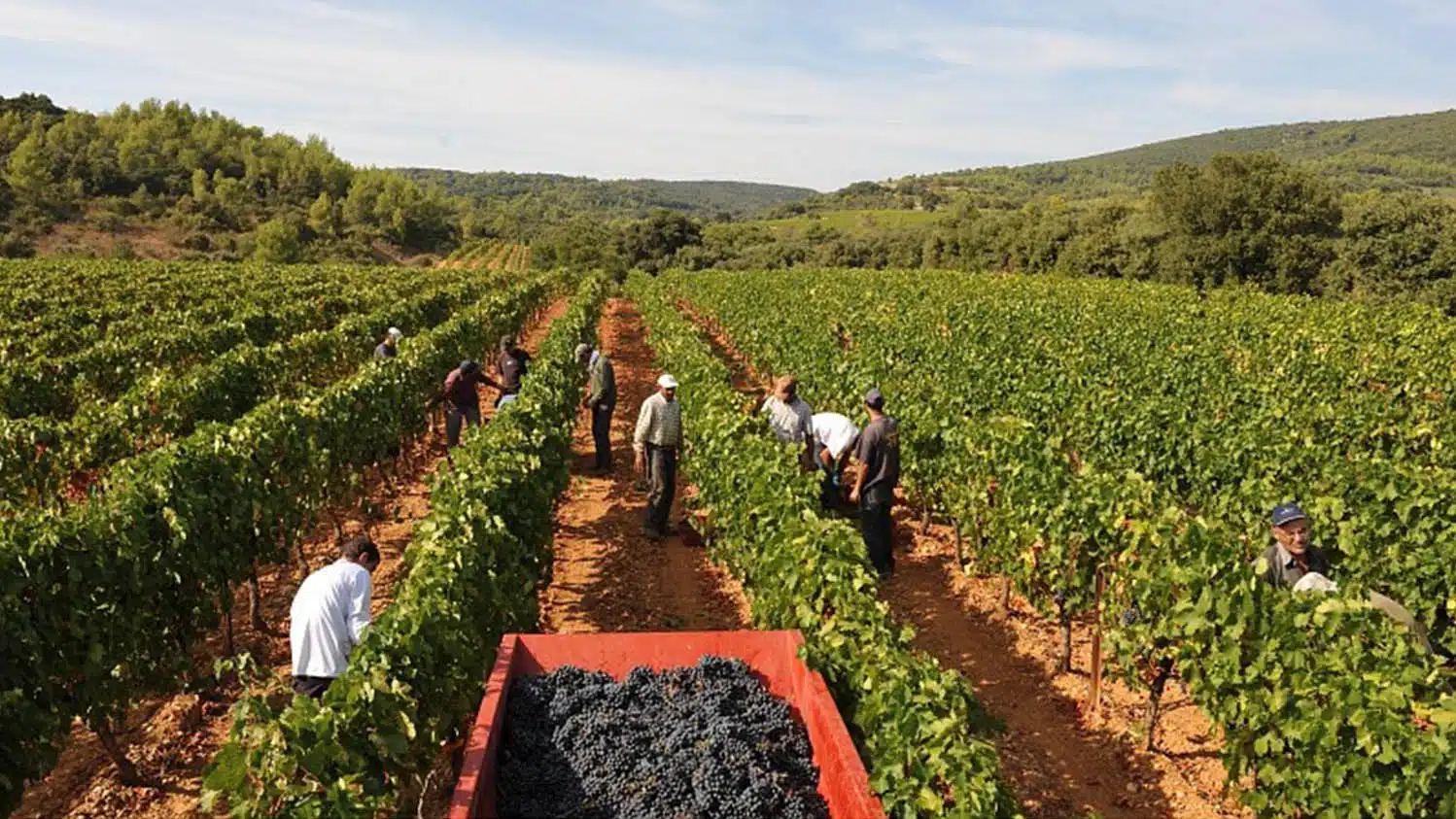
The Group leases a high-quality vineyard to a professional Languedoc-Roussillon winegrower. The choice of vineyards is based on rigorous criteria such as the location, the reputation of the Appellation or the growth prospects.
> Why the Languedoc-Roussillon region when it comes to wine investment?
The Languedoc-Roussillon vineyard covers an area of 42,800 hectares and extends across 4 départements such as the Aude, the Gard, the Hérault and the Pyrénées-Orientales.
Its annual yield is around 1,800,000 hectolitres. Located in a Mediterranean climate zone, the region is characterised by mild winters, hot summers and very little rainfall. The wind that sweeps over the region, the Tramontane, contributes favourably to drying the vines and prevents disease.
This remarkable climate is therefore conducive to growing vines.
A little history: the Greeks were, in the 5th century BC, the pioneers of winegrowing by importing the first vines into the Languedoc-Roussillon region. The Romans then took over, after which the vine grew rapidly until the 17th century. In 1863, phylloxera (a vine disease caused by an insect of the Phylloxeridae family), ravaged the French vineyards. When this scourge of the vines was eradicated, the region’s cultivable area expanded considerably to become one of the largest vineyards in France. In 1970, the introduction of noble grape varieties brought renewed popularity to Languedoc-Roussillon wines.
The best-known main grape varieties are cabernet-sauvignon, merlot, black grenache and white grenache, muscat, clairette, and mauzac. The grape mix benefits from the great diversity of the soil made up of schist, sandstone, limestone and marl, which accounts for the richness of the terroirs and the diversity of the AOCs on offer.

> The taxation of the Languedoc-Roussillon GFV
The income received by the investor is taxed in the category of property income. The micro-foncier regime is an option that concerns people whose property income does not exceed €15,000 and which applies to dividends from GFVs while benefiting from a flat-rate allowance of 30%.
The micro-foncier regime proves advantageous when the investor has bought their shares outright, since in that case they have no interest charges to deduct.
The actual (réel) regime is another interesting option. The investor can deduct from their income from the GFV the charges such as property taxes, insurance or other management fees. When the financing is done on credit, the taxpayer can subtract the amount of interest from their GFV income and reduce their taxable base.
It should be noted that this regime must be the subject of a prior request to the tax authorities. Once the option is chosen, it remains irrevocable for 3 years.

In return, investors undertake to keep their respective shares until 31 December of the 5th year following the investment. Note that only very few GFVs have benefited from this mechanism.
> Presentation of a few Appellations in Languedoc-Roussillon
- AOC Les Terrasses du Larzac - AOC Languedoc
- AOC Coteaux-du-Languedoc - Terres de Sommières
- AOC Coteaux-du-Languedoc - Pic Saint-Loup
Located on the vast Larzac plateau, north-east of Montpellier, the Terrasses du Larzac received the Controlled Designation of Origin (AOC) in 2014. This vineyard stands out for its freshness and its winds which sweep across the mountain plateau.
This atypical geographical situation gives rise to a wide temperature range and favours the slow, gradual ripening of the grapes. The appellation produces only red wines and has already gained a great reputation thanks to its early-drinking style and the aromas of its wines.
The AOC Coteaux du Languedoc Terres de Sommières is a regional appellation covering 18 communes. It produces around 7,858 hectolitres on limestone and marl soils. The vines stretch along the hillsides below the Cévennes. The grape varieties mainly used are syrah and grenache. The estate produces a full-bodied wine, with notes of red fruits and black cherry, perfectly suited to pairing with strongly flavoured dishes such as game.
The AOC Coteaux-du-Languedoc Pic-Saint-Loup, located 20 km north of Montpellier, proves to be a recognised soil-and-climate zone.
This Appellation covers an area of 900 hectares and its production of red and rosé wines is around 25,000 hectolitres per year. The soils are characterised by their high density of limestone, marl and clay. Subject to the influence of the Mediterranean and continental climates, the temperature variations observed allow an end of ripening that is favourable to grape quality and the production of fine wines.
Favouring grenache, mourvèdre and syrah, these must represent a minimum of 90% for the reds and 70% for the rosés. The red wines are reflected in their spicy flavour combined with a hint of ripe fruit. The rosés stand out for their subtle aromas of raspberry and strawberry.

An investment in a Vineyard Land Group remains above all a way to diversify your assets and is aimed mainly at epicureans, connoisseurs and lovers of fine wines. The tax aspect also offers significant value for investors, who can benefit from attractive advantages depending on their wealth situation.
While it has similarities with the acquisition of agricultural land, it should be stressed that buying vines via the GFV benefits from greater flexibility of acquisition. This type of investment seems to have a bright future ahead of it and should surprise us in the future with its scale and its democratisation.
Contact the firm to invest in a Languedoc-Roussillon vineyard
All regional opportunities to invest in French vineyards
Discover the other French wine regions where vineyard land groups (GFV) are regularly offered to private investors.
Alsace | Bordeaux | Burgundy | Rhône Valley | Champagne | Beaujolais | Languedoc-Roussillon | Jura | Loire Valley