
GFV CHÂTEAUNEUF-DU-PAPE
Why Invest in a Wine Land Group in Châteauneuf-du-Pape?
CHÂTEAUNEUF-DU-PAPE Wine Land Group in progress
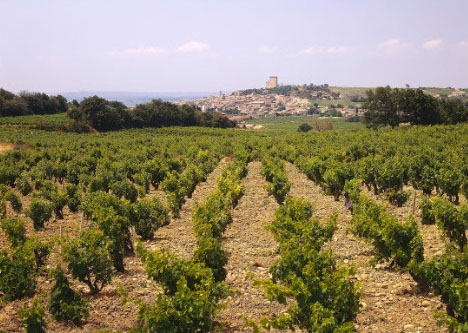 From €6,100
AOC Châteauneuf-du-Pape
- Estate spanning 43 hectares
- Vineyard farmed under Organic Agriculture
- Diversification of grape varieties
- In-kind allocation: 7 Bottles (Châteauneuf-du-Pape Classic Red)
- Non-guaranteed return above +4.25 % marketing fees included
CONTENTS
- How a Châteauneuf-du-Pape GFV works?
- Reasons to invest in a GFV in Châteauneuf-du-Pape.
- Taxation of the Châteauneuf-du-Pape GFV.
- Overview of the appellation’s GFVs.
If you do not have the funds needed to acquire an entire wine estate in Châteauneuf-du-Pape or the technical expertise to manage an estate directly, it is worthwhile to invest in a Châteauneuf-du-Pape GFV.

How a Wine Land Group works in Châteauneuf-du-Pape
It is a non-farming agricultural land group whose objective is the collective ownership of a wine estate in the Châteauneuf-du-Pape appellation.
A legal vehicle is created in order to buy the vineyard. The latter is then leased through a long-term lease (18 years, tacitly renewable) to an experienced winegrower.
More simply, it involves a small number of individuals (private savers) who invest together to buy an estate and manage it collectively through a Management Company (Bacchus Conseil). The latter set up the Châteauneuf-du-Pape GFV in its entirety. The income, after deduction of management fees, is distributed annually in kind (bottles of wine) or in cash.
Why invest in a vineyard located in Châteauneuf-du-Pape?
Created in 1936, the Châteauneuf-du-Pape AOC is the first wine appellation in France, of international renown. It extends over 3,165 hectares spread over 5 municipalities, between Avignon and Orange.
The history of the vineyard is of course linked to that of the papacy, established at the end of the Middle Ages in Avignon. From the 14th century, Pope Clement V had numerous vines planted. It was Pope John XXII who had a castle built on the slopes of the left bank of the Rhône, which became their summer residence.
The terroir is exceptional for its geological diversity rolled pebbles, limestone, Miocene sands and sandstone, red sandstone. The rolled pebbles store heat during the day to release it at night, ensuring optimal ripening of the grapes. The mistral, the region’s characteristic wind, is the appellation’s other great asset: it ensures the quality and typicity of the wines.
The Châteauneuf-du-Pape AOC is subject to strict production rules concerning the cultivation methods of its 13 grape varieties authorised. The wines of Châteauneuf-du-Pape are recognisable among all others: they have an inimitable style, combining power, aromatic complexity and elegance. An essential appellation for wine lovers and an excellent vehicle for heritage investment.

Taxation of the Châteauneuf-du-Pape GFV
At first glance, the idea of making a long-term investment in a wine estate with a view to obtaining profits may seem unclear to you. Can tax advantages really arise from it?
Indeed, the winegrower will remunerate the various shareholders of the Châteauneuf-du-Pape Wine Land Group through income derived from the ‘fermage’ (rent). This income can be paid either in cash(money to the members) or in kind, that is to say in bottles of wine from the estate.
When it is a payment in the form of bottles of wine, the return is improved insofar as the member receives their bottles valued at production cost, well below the marketing price. This type of investment is intended for people who wish to invest in a tangible, rare and prestigious asset, for wine lovers, but also for people who have estate transmission concerns.
It is an effective tool for estate transmission and IFI (wealth tax) optimisation
In terms of IFI optimisation, the holders of GFV shares benefit from a partial IFI exemption. The value of the shares is reduced by 75% up to a limit of €101,897 and by 50% when this threshold is exceeded. The benefit of this exemption is granted to shares held for more than 2 years.
Any transfer free of charge, that is to say a gift or inheritance, is exempt from duties up to 75% of the amount transmitted up to a limit of €600,000 per heir or donee, and 50% beyond this limit.
For people with transmission, gift or inheritance concerns who have used up their allowance, the Châteauneuf-du-Pape GFV is a solution that could address these concerns.
GFV income
The income earned by the investor from the Châteauneuf-du-Pape GFV is taxed under the regime of property income, more specifically the micro-foncier regime as long as it does not exceed €15,000 per year.
Taxation of capital gains
Capital gains, in the event of resale of the shares, are taxed under the regime specific to property capital gains, with a 6% allowance per year from the 6th to the 21st year, then 4% for the 22nd year. Capital gains are exempt from social levies after a holding period of 30 years.
In summary, with a Châteauneuf-du-Pape Wine Land Group, you will benefit from advantageous taxation, build up a prestigious cellar, a capital that is easily transmissible to your loved ones, and take part in the life of your wine estate at general meetings.
Châteauneuf-du-Pape GFV review
Châteauneuf-du-Pape remains, in my eyes, in a category of its own.
Why does this appellation matter so much to me?
First of all for a simple reason: the scarcity of the land.
With only 3,165 hectares delimited since 1936 — it is the first AOC in France — it is structurally impossible to enlarge the vineyard. When you consider that global demand for these wines keeps growing, you understand that owning a fraction of this land, even a few ares, constitutes an asset whose intrinsic value is real and lasting.
It is not a sales pitch: it is geography and history.
Then, for the quality of the estates we offer. When I work with Bacchus Conseil to select a GFV in the appellation, I do not put forward just any estate.
- The Domaine Galévan, run by Coralie Goumarre — a winegrower whose family has farmed this land since 1836, organically since 2008 —
- or the Domaine de La Palud with its cuvées rated 92/100 by the Wine Advocate.
These are estates that have a soul, a history, a coherence.

GFV Domaine Galévan – AOC Châteauneuf-du-Pape / Côtes-du-Rhône
Domaine Galévan was created in 1836 by Jean-François Goumarre. It has belonged to the same family for more than 180 years. Today, Coralie Goumarre, the first woman to take charge of the estate’s destiny, embodies the 9th generation and chairs the association Femmes Vignes Rhône.
Located in the municipality of Courthézon, the estate spans 60 hectares. The entire vineyard is farmed under Organic Agriculture since 2008. The vines are spread over the Châteauneuf-du-Pape, Côtes-du-Rhône Villages and Côtes-du-Rhône appellations. The average age of the vines is 65 years, producing very high quality grapes in small quantities.
The GFV Domaine Galévan will own 2 ha 36 a 44 ca(including 1 ha 37 a 74 ca in AOC Châteauneuf-du-Pape, 36 a 98 ca in AOC Côtes-du-Rhône Villages, 48 a 82 ca in AOC Côtes-du-Rhône), in the municipality of Courthézon. The total capital of the GFV is 753 500 € for 137 shares.
The approach favours a farming that respects living things, with certified organic practices since 2008, giving the wines fine, balanced and authentic aromas. Coralie’s two sons, Julian and Clément, representing the 10th generation, will join the estate, thereby perpetuating the family adventure.
3 cuvées distributed in the allocation
- AOC Châteauneuf-du-Pape red– Blend: 80% Grenache, 20% Mourvèdre. Nose of candied fruit, garrigue and spices. Full and unctuous palate. 15 months’ ageing in barrels.
- AOC Côtes-du-Rhône Villages white « Les Capucins »– Blend: 40% Roussanne, 40% Marsanne, 20% Clairette. Mineral nose, notes of fresh almonds and bergamot.
- AOC Côtes-du-Rhône red « Paroles de Femmes »– Blend: 60% Grenache, 20% Mourvèdre, 10% Cinsault, 10% Carignan. Black cherry colour, black fruits, wild berries, spices.
GFV Domaine de La Palud – AOC Châteauneuf-du-Pape
A family property whose building was constructed in the 13th century by the Templars. The Domaine de La Palud has belonged for 7 generations to the same family. In 1841, Pierre-Joseph Grangeon, a former tenant farmer, acquired the property. Today, Marie-Laure Grangeon has taken up the torch with her children Céline and Nicolas, perpetuating the cultivation of Grenache and Syrah on the rolled pebbles typical of the appellation.
The estate covers 14 hectares of vines in Châteauneuf-du-Pape (Red and White), Côtes du Rhône and Vin de Pays Principauté d’Orange. Certified Organic Agriculture since 2017, it is farmed according to a qualitative approach combining ancestral expertise and respect for the environment.
The GFV Domaine de La Palud covers 2 ha 00 a 12 ca of vines in AOC Châteauneuf-du-Pape (lieux-dits Les Galimardes and Les Coulets). Grape varieties: Syrah, Grenache, Mourvèdre. The capital of the GFV is 1 211 000 € for 173 shares.
The Châteauneuf-du-Pape red « Tradition », made from vines 45 years old, received a rating of 92/100 from the Wine Advocate(2016) and from James Suckling(2016). Gold Medal Orange 2019. A wine with a deep ruby colour, aromas of bay, thyme, morello cherry and spices, with a powerful, silky palate and fine tannins.
Cuvées distributed in the allocation
- Châteauneuf-du-Pape red « Tradition »– Grenache (45%), Syrah (30%), Mourvèdre (15%), Cinsault (5%), Counoise (5%). Aged in demi-muid casks. Cellaring 10 years+.
- Châteauneuf-du-Pape white « Tradition »– Grenache blanc (50%), Clairette (30%), Bourboulenc (10%), Roussanne (10%). Wine Advocate 91/100 (2019).
Management is provided by Bacchus Conseil, guaranteeing simple, transparent and friendly management, with returns in kind or in cash and a regular revaluation of the shares (set every three years at the general meeting).
Contact form regarding the Châteauneuf-du-Pape GFV
All regional opportunities to invest in French vineyards
Discover the other French wine regions where vineyard land groups (GFV) are regularly offered to private investors.
Alsace | Bordeaux | Burgundy | Rhône Valley | Champagne | Beaujolais | Languedoc-Roussillon | Jura | Loire Valley