
GFV shares for sale
INVEST IN A GFV
Become co-owner of a Wine Estate of your choice from €7,500
GFV currently available 🍇
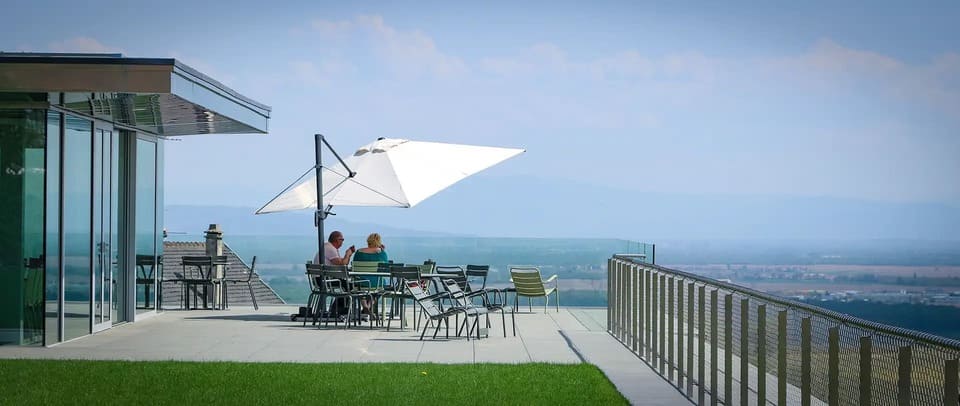 From €5,000
AOC Alsace
Towns of Vieux-Thann and Steinbach (Haut-Rhin)
- Estate of 6 ha 31 a 05 ca at the southern gateway to the Alsace vineyards
- Family estate with 300 years of history, 12 generations of winegrowers
- Certified Organic Farming and HVE 3
- Distribution in kind: 12 Bottles (Crémant, Pinot Gris Grand Cru, Pinot Noir, Riesling, Gewurztraminer VT, Pinot Gris SGN)
- Non-guaranteed return over +4,62 % marketing fees included
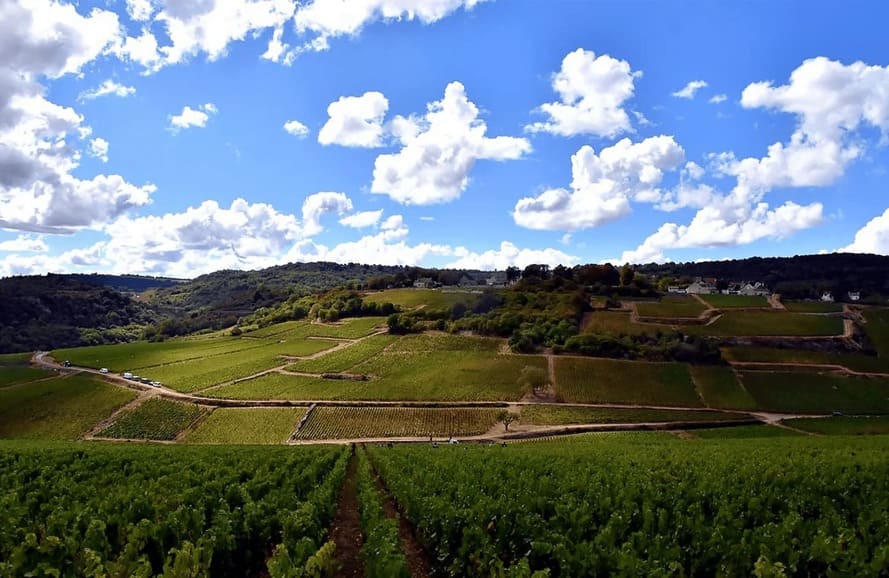 From €15,000
AOC Volnay 1er Cru
Locality of Chanlin, Côte de Beaune (Burgundy)
- Plot of 40-year-old vines at 300 m altitude
- Winegrower since 1758, 8 generations
- Certified Organic Farming and Biodynamics (Biodyvin)
- Distribution in kind: 6 Bottles of Volnay 1er Cru (or equivalent voucher)
- Non-guaranteed return over +3,8 % marketing fees included
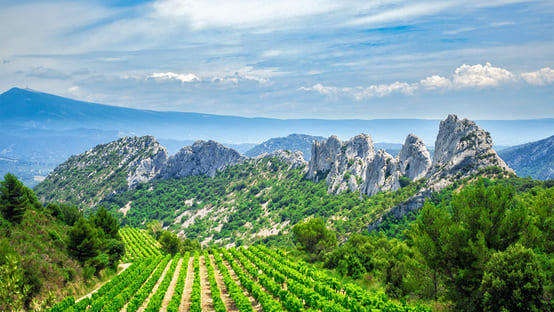 From €5,600
AOC Gigondas & Vacqueyras
Domaine du Pesquier, Gigondas (Vaucluse)
- Total area of 2 ha 29 a 22 ca across Gigondas and Vacqueyras
- Family farm since 1556, 4 generations of winegrowers
- Grenache Noir, Syrah and Mourvèdre grape varieties - Gold Medal at the Paris CGA 2026
- Distribution in kind: 12 Bottles (9 Gigondas Red + 3 Vacqueyras Red)
- Non-guaranteed return over +4,17 % marketing fees included
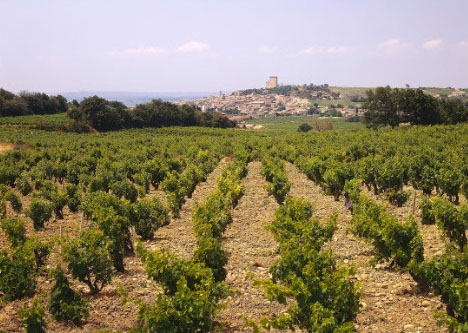 From €6,100
AOC Châteauneuf-du-Pape
Towns of Châteauneuf-du-Pape and Courthézon
- Estate spanning 43 hectares
- Vineyard managed under Organic Farming
- Diversification of grape varieties
- Distribution in kind: 7 Bottles (Châteauneuf-du-Pape Classic Red)
- Non-guaranteed return over +4,25 % marketing fees included

AOC Beaujolais, Brouilly
Plots located in Belleville, Charentay and Saint-Lager
- 7 hectares 47 ares 19 centiares
- AOC Beaujolais red, Beaujolais white, Crémants de Bourgogne, Bourgogne white and Brouilly
- Family estate founded in 1995, bringing together 3 generations
- 24 bottles from the Estate
- Non-guaranteed return over +4,28 % marketing fees included
Yield and capital not guaranteed. The winegrower may be unable to pay you in the event of a poor harvest.
Secondary Market
GFV shares available immediately, with no waiting for the grouping to be set up.
Priority access reserved for our long-standing clients.
The GFV secondary market offers an immediate and rare way to access exceptional vineyards, with no set-up delay or waiting period. These shares, sold by existing partners, benefit from a documented track record of appreciation and a distribution in bottles often higher than that of a newly created GFV.
It is also an opportunity to enter renowned and hard-to-access estates, whose winegrowers have already proven themselves over time. An opportunity for tangible wealth diversification, backed by real wine assets, in top-tier appellations.
Immediate access
No waiting for the grouping to be set up. You become a partner as soon as the transfer deed is signed.
Proven appreciation
The share value shows a real track record of appreciation — up to +40% on certain GFVs.
Higher distribution
The annual distribution in bottles is often higher than at the GFV's initial creation.
Favourable taxation
75% allowance on gift and inheritance transfer duties as part of an estate transfer.
Châteauneuf-du-Pape
Created in 2009
Plots on the clay-limestone plateau of Maucoil, one of the most prized terroirs. Appreciation of +40% — a rare opportunity on the secondary market.
★ High performanceChâteauneuf-du-Pape
Created in 2019
Hundred-year-old vines on one of the appellation's great terroirs — remarkable depth and complexity. A rare opportunity to access this exceptional wine heritage.
↑ +11% since creationAlsace — Grand Cru Hengst
Created in 2013
Grand Cru Hengst, one of Alsace's most illustrious terroirs, cultivated for several centuries. Wines of great finesse and longevity, recognised internationally.
— Stable valuePessac-Léognan
Created in 2018
Renowned gravel terroirs in Pessac-Léognan, managed with rigour. A confidential reference within the Bordeaux appellation, marked by the consistency of its vintages.
↑ +11% since creationLussac Saint-Émilion
Created in 2015
Clay-limestone soils of Lussac, a satellite appellation of Saint-Émilion. A collective of winegrowers united for over 70 years, combining shared expertise and consistent quality.
— Stable valueBergerac · Monbazillac
Created in 2019
Périgord hillsides producing distinguished dry Bergerac and sweet Monbazillac wines. A terroir gaining recognition, accessible at an attractive entry ticket.
↑ +11% since creationLanguedoc · Pic Saint-Loup
Created in 2017
16 hectares managed with rigour on the terroirs of Pic Saint-Loup. Typical, fresh wines thanks to the temperature range of the Cévennes — character and elegance in all seasons.
— Stable valueYield and capital not guaranteed. The winegrower may be unable to pay you in the event of a poor harvest.
Why invest in and buy GFV shares online?
- Become the Owner of rare and prestigious Appellations
- Help preserve an ancestral expertise
- Diversify your wealth into a real, tangible asset (French vineyards)
- Receive a supplementary income
- Pass on your capital under optimal conditions
- Get Bottles at a preferential rate
THE WINE EXPERT SHARES HIS VIEW ON GFVs
After being a pioneer in forestry investment, our firm intends to democratise wine investment through GFVs.
It is a relevant opportunity to diversify your wealth into a tangible, real asset, while championing a certain idea of France.

A few achievements in Wine Land Groupings

AOC Alsace
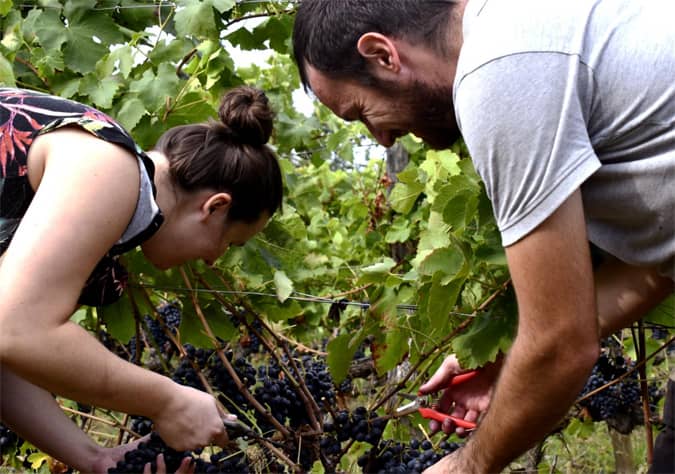
Nestled on the heights of Alsace, this 8-hectare estate specialises in producing superior-quality Rieslings. Located at a minimum altitude of 380 metres, it benefits from a unique terroir that gives its wines remarkable finesse and elegance.
Committed to a sustainable approach since 2015, the estate is certified organic.
The result: exceptional Alsace Rieslings, at once delicate, elegant and generous, which perfectly reflect the richness and typicity of this high-altitude terroir.
 AOC Saint-Joseph
Located at the heart of the Saint-Joseph Appellation, this Estate embodies the passion and renewal of a young generation of winegrowers.
Across nearly 2 ha of vines under organic conversion, it carries on the demanding work of the granite hillsides, shaped into terraces. The Syrah and Marsanne grape varieties thrive here, producing powerful reds and elegant whites, true to the tradition of the northern Rhône valley.
Here, the desire for balance between respect for the terroir, enhancement of heritage and innovation in winegrowing practices is combined with a family-run, modern vision of the winegrower's craft, offering exceptional appellation wines.

Domaine Moissenet-Bonnard
The Moissenet-Bonnard Estate now produces Appellations ranging from Puligny-Montrachet to Nuits-Saint-Georges across 6.29 ha.
The Pommard terroir is of course the most represented, with no fewer than 6 appellations, including 3 premiers crus.
The cellars and winery are located on rue des Jardins in Pommard, just behind the Château. Client welcome and tastings take place daily.
 Bourgogne Fixin 1er Cru
Domaine Guy et Yvan Dufouleur
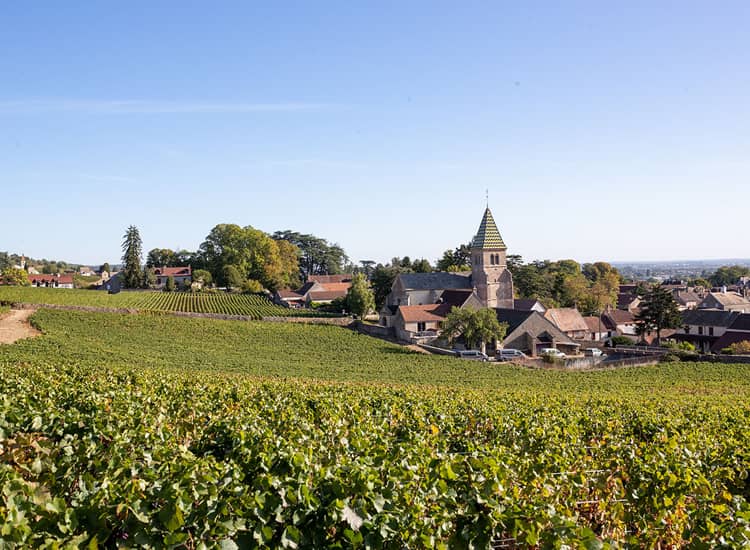
The Dufouleur family has been rooted for more than 400 years in the terroir of Nuits-Saint-Georges, at the heart of the Côte de Nuits and the Burgundy vineyard climats listed as World Heritage.
Winegrowers from father to son, the Estate covers an area of 30 hectares and is now managed by Yvan Dufouleur, the eldest son of Guy Dufouleur.

Maison en Champagne Grand Cru
Winegrowers from father to son, the M. Family has passed on to each generation its passion for the vine and its entrepreneurial drive.
Founded in 1929, it is one of the oldest cooperative structures in Champagne. The first 24 member winegrowers all shared the fact of owning vines in the single village of Mailly Champagne and the concern to better sell their harvest to the champagne houses by joining together as a company.

AOC Châteauneuf-du-Pape
More than 400 years of history. The 25 hectares of vines in the Châteauneuf-du-Pape appellation have been farmed organically since 2011.
 Alsace Gewurztraminer
Alsace
The Domaine de R. is above all a family affair that began in 1908 with Joseph R. Later, the children, Marthe and René, then the grandchildren Annick and Jean-Claude, contributed to the estate's reputation among many wine lovers.

Domaine Jacques Lemenicier
Life is sometimes marked by opportunities. It is above all thanks to a great deal of hard work, training (in Beaune) and good advice from supportive winegrowers that Jacques Lemenicier now has a fine estate of nearly 9 ha in Cornas, Saint-Péray and Crozes-Hermitage.
GFVs structured and offered by our partner Operation Arrangers.
WHAT IS A GFV?
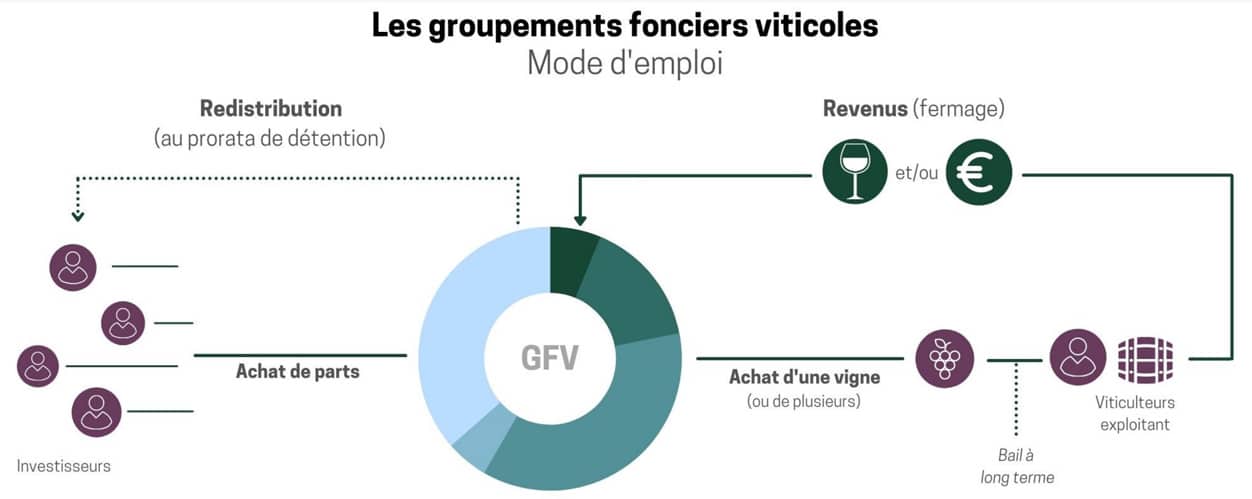
A GFV (Groupement Foncier Viticole / Wine Land Grouping) is a non-trading company (société civile) structure whose capital is divided into shares. These shares are acquired by individuals, who thereby become partners in the company.
The profits generated, after deducting management costs and taxes, are distributed each year either as bottles of wine from the Estate or in cash.
These land investments offer a genuine opportunity to diversify one’s asset portfolio, placing your money in a tangible product while contributing to the social economy and sustainable development. The significant financial benefits they offer should not be overlooked either.
Free PDF Guide
Discover the first one quickly
FREQUENTLY ASKED QUESTIONS ABOUT THIS RISING INVESTMENT AMONG FRENCH AND EXPATRIATE SAVERS
What is the return on a Vineyard investment?
Let’s be clear: for decades, no investor has come looking for high returns through this investment. The reasons to invest are different: terroir, ecology, the social and friendly bond with the winegrower and the other partners, the pleasure of tasting ‘your’ wine, the French art of living (patriotism).
____
What return if you opt for a cash distribution?
The average return is 1.8 – 2% per year if you opt for Cash.
It depends on the winegrower’s ability to generate value by marketing a quality wine. This allows him to pay the rent (which he must pay no matter what) to the Grouping in which you are a shareholder alongside other savers.
____
Opting for a distribution in kind (bottles) multiplies your return
Most investors opt each year for the distribution in kind: bottles of wine.
In this case, the ‘return’ rises to +4.5% per year, since the shareholder obtains bottles at a preferential rate versus a retail price that is, in practice, 3 or even 4 times higher. 90% of our clients choose to receive bottles rather than cash.
____
Strong potential for capital gains linked to the land
The land appreciates over the long term. A pocket of considerable capital gains lies here. Nevertheless, the proportion of investors reselling their GV shares is almost nil.
Who handles the Management?
- The day-to-day management of the Groupement Foncier Viticole (GFV) is handled by the Operation Arranger’s team, freeing investors from any administrative burden. A long-term rural lease, of at least 18 years and transferable outside the family framework, is established with a winegrower who farms the land.
- The GFV does not carry out direct farming and owns no buildings, which spares the partners any potential renovation costs. The GFV’s income comes from the rent (fermages), the amounts of which are set each year by prefectural decree.
- A detailed management report, including the evolution of the investment and the income to be declared, is sent to the partners each year. Finally, every three years, the revaluation of the GFV shares, based on the evolution of land prices in the Appellation, is submitted to the decision of the General Meeting.
How to acquire shares?
HOW TO RESELL YOUR GFV SHARES?
GFV SECONDARY MARKET
It is possible to resell your G.F.V. shares on the secondary market. The challenge is to sell at the right price.
> Given the recurring scarcity of new Wine Groupings in France, private over-the-counter sales between individuals or through a Professional work perfectly well.
> In addition, each year following the General Meeting, the Partner receives an indicative price for the evolution of land prices for the Appellation. This price is established by considering the average prices of available land, recorded by the SAFER (French rural land management agency) every year, presented in April each year.
An updated value of each Property excluding leasing, set individually by the regional SAFER in November each year.
Before investing in a G.F.V., it is wise to check that the purchase price truly matches the prices of the Appellation in question. If this information is missing or incomplete in the Grouping’s documentation, we invite you to get in touch with an Expert.
Transfer of shares: Fixed-Capital GFV VS Variable-Capital
The transfer price of the shares is set every three years at the general meeting. It is revalued according to the evolution of land prices indicated by the SAFER.
A pre-emption right is granted to the farmer, making him a priority for buying back the shares, except in the case of a transfer between spouses, ascendants and descendants.
A distinction should be made between 2 types of G.F.V.:
A. The fixed-capital Groupement Foncier Viticole: the Partner may transfer all or part of his shares whenever he wishes, provided he finds a buyer and pays the Registration Duties (4.8%).
B. The variable-capital Groupement Foncier Viticole: the Partner may transfer his shares at any time if he has found a counterparty; he can then transfer his shares without any Registration Duty to pay.
Eligible for a legal entity?
No.
Article L322-1 of the French Rural and Maritime Fishing Code specifies that the GFA is a non-trading company made up exclusively of natural persons.
Differences between GFVs (Groupements Fonciers Viticoles) and Foncières Viticoles
You have two options for investing in vineyards in France:
- In a vineyard directly;
- or through a collective investment vehicle, generally managed by a Management Company approved by the Regulator.
Regarding this last option, a distinction should be made between the G.F.V and the Foncière Viticole (Wine Real Estate Company). While these vehicles pursue the same goal, they differ only in terms of taxation.
Here is a table to identify the differences between GFVs (Groupements Fonciers Viticoles) and Foncières Viticoles:
| Groupement Foncier Viticole (GFV) | Foncière Viticole (Wine Real Estate Co.) | |
| Income Tax Reduction (art. 199 Terdecies 0-A of the French Tax Code) | A Groupement Foncier Viticole (or G.F.V.) does not grant any Income Tax reduction (IR — Impôt sur le Revenu). |
The Income Tax reduction is possible when the Foncière Viticole’s activity is agricultural, which is sometimes the case. Thus: Income tax reduction of 25% of the amount invested in the Foncière Viticole, up to a subscription of €50,000 for a single person and €100,000 for a couple, i.e. a tax reduction of €9,000 and €18,000 respectively. This tax break falls within the overall cap on tax loopholes of €10,000. In return, the shares of the Foncière Viticole are locked in for a minimum period of between 5.5 and 7 years, subject to the secondary market for the shares. |
| Allowance on Transfer duties (art. 793 of the French Tax Code) |
Once the G.F.V. grants a long-term lease to a farmer, it is possible to benefit from this tax scheme: 75% allowance on tax duties in the event of transfer (gift or inheritance) up to €600,000, then 50% beyond that, with no upper limit. This allowance applies to the value of the wine assets (in other words, cash is excluded from the calculation base). In return, the G.F.V. shares must be held for 2 years before the transfer, then kept for a minimum of 5 years by the heirs or beneficiaries. A scheme that works without any condition of lineage. |
The transfer allowance applies only to the direct ownership of vineyards or ownership through a Groupement Foncier Viticole. The Foncière Viticole, being a public limited company, unfortunately does not benefit from it. |
What are the different fees?
- Entry fees: around 10%.
- Management fees: around 3% per year for certain GFVs, or an annual flat fee of around €2,000.
- Transfer fees for a fixed-capital GFV: 4.8% Registration Duties.
- Transfer fees for a variable-capital GFV: no fees.
Is it possible to get bottles at a preferential rate rather than an annual income?
- If the Partner opts for payment in the form of bottles of wine (distribution in kind), these are valued at the production price (a discount of 25% to 60% compared to the retail price).
- If the Partner instead decides to receive his dividends in cash, he can buy the wine from his Grouping at an owner’s rate. The number of bottles depends on the amount of his investment.
How rare is this investment?
It is often said that GFVs are rare — so much so that you have to join a waiting list to get one.
On a scale of 0 to 100 measuring the scarcity of the investment, it is fair to say that the GFV sits at 90%.
While some Groupings sometimes take longer to market, overall it can be said that this investment easily finds investors.
What, in our view, are the reasons behind the scarcity of Wine Groupings?
A. The number of Partners is generally limited to 150 (in order to comply with legislation on investments involving a public offering of savings). Some Operation Arrangers reduce the number of subscribers even further, to just 70 or even 50, in order to create an intimate, close-knit atmosphere among the Partners.
B. The GFV is little known. This lack of awareness creates strong scarcity among the general public. But this is changing faster than we are writing these lines, particularly among the younger generations born in the 1990s who find ‘meaning’ in it. GFVs are now well identified by Wealth Management Advisors who offer them to their clients; the Internet also makes information easier to obtain.
C. Globalisation is attracting foreign buyers ready to invest in the most prestigious French Estates. This drives up prices and dries up the opportunities to set up new Groupings.
D. Groupings targeting the most prestigious Estates are incredibly sought-after. 75 shares of a GFV in Burgundy were sold in less than 4 hours, for example; even though the number of shares each Wealth Advisor could market was limited to just two and the ticket for one share was €55,000.
Risks of wine investment
Capital risk
The GFV offers no capital guarantee. The value of the land can vary depending on various factors such as the wine market, the reputation of the appellation, weather conditions, etc.
Liability of the partners
The partners are held liable for any debts of the grouping, each in proportion to the shares they hold (generally, GFVs created by Bacchus Conseil or Canovia are not in debt).
Liquidity risk
Liquidity depends on the subscription or purchase requests for shares recorded by the management.
Risk relating to the rent (fermage)
The amount of the rent is subject to variations in the annual prefectural decree, which may increase or decrease each year.
Risk of non-payment
The amount of rent paid by the farmer may be subject to a risk of non-payment.
Taxation applicable to your wine investment

Taxation of your income
> The saver is taxed on the share of rent received, not on the retail value of the bottles received if he has opted for the distribution in kind.
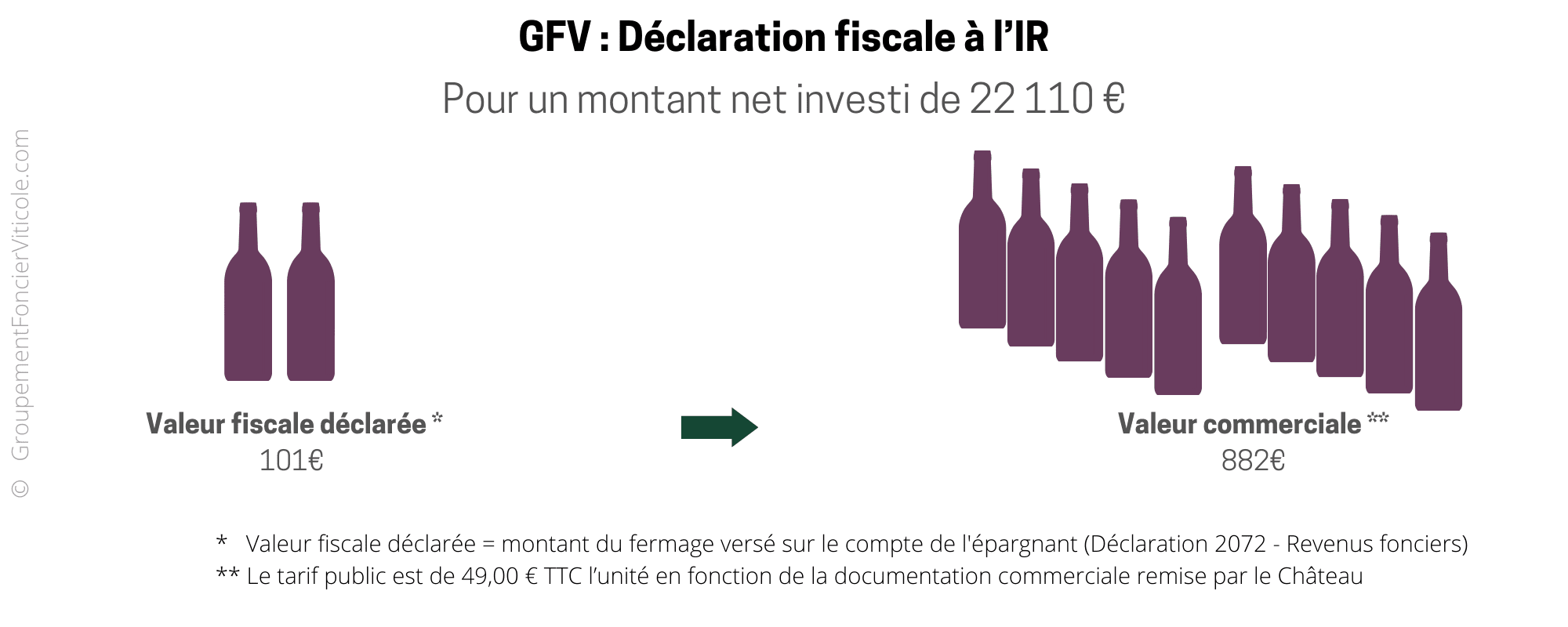
> The income received is treated as property income. You can therefore benefit from the micro-foncier scheme (option 1) by declaring only 70% of the amounts received each year (30% allowance). This is, however, only possible if your annual property income does not exceed €15,000.
> You will also have the option of choosing the actual-expenses scheme (régime réel) (option 2) by deducting the costs related to the Grouping: management fees, property taxes, but also your annual interest if you make your investment on credit (and if your bank decides to allocate the loan to this investment, which is not always straightforward).
The expenses are recorded by the GFV’s Management Company and reported to the Partners each year so they can complete their Tax return.
Please note: once you have opted with the Tax Authorities for the actual-expenses scheme, no return to the micro-foncier scheme will be possible for 3 years.
What tax applies in the event of resale?
If you wish to resell your GFV shares, you will need to declare the capital gain generated. This is governed by the real estate capital gains regime (and not the movable-property one).
You will thus benefit from a full tax exemption after 30 years of holding the shares.
This full exemption is also allowed if the sale amount of your shares is less than €15,000.
In other cases, you benefit from a progressive allowance on the amount of the capital gain to be declared, depending on the number of years held. So the longer you hold your G.F.V. shares, the lower the taxable base of your capital gains on disposal. The tax on this taxable base is 19% under the flat-rate withholding and 17.2% for social contributions, i.e. a total of 36.2%.
In the event of inheritance or gift
You have the option of giving your shares directly to your children or to a third party to plan your estate transfer in advance.
Likewise, in the event of death, the shares will not be liquidated but passed directly to your heirs, who will in turn become partners in the Groupement Foncier Viticole.
The transfer duties in the event of a gift or inheritance will be low.
Indeed, the heirs or beneficiaries will benefit from a partial exemption of 75% on the value of the shares received up to €600,000, then 50% beyond that.
This tax advantage is, however, part of a continuity requirement. The G.F.V. shares must be held for at least 2 years before being transferred, and the heir or beneficiary will in turn have to keep them for a minimum of 5 years.
If these conditions are not met, the Tax Authorities will carry out a clawback.
Groupement Foncier Viticole shares are a genuine tool for optimising your estate transfer.
| EXAMPLE | |
| Value of the estate | 100 000 € |
| Minority shareholding allowance | 10 000 € |
| 75% allowance | 67 500 € |
| Taxable | 22 500 € |
| Duty payable of about 20% for a child | 4 500 € |
| Duty payable of about 55% for a nephew or niece | 12 375 € |
| Where there is a direct-line heir |
| In comparison, the duty payable on an estate of €100,000 is normally |
| €20,000 = 100,000 x 20%. |
| The saving is therefore €15,500 for the children. |
| Where there is no direct-line heir |
| In comparison, the duty payable on an estate of €100,000 is normally |
| €55,000 = 100,000 x 55%. |
| The saving is therefore €42,625 for the nephews and nieces. |
Real Estate Wealth Tax - IFI
If you are liable for the IFI, you will not, however, be taxed on 100% of the value of your G.F.V. shares.
The exemption is based on a 75% allowance on the value of the shares up to €101,897, then 50% beyond that.
Three conditions must be met to benefit from it:
- The lease must meet the definition of the Rural and Maritime Fishing Code and be concluded for a minimum term of 18 years.
- The shares must have been held for at least 2 years by the taxpayer.
- The GFV’s articles of association must provide for the prohibition on Partners farming the land directly.
Is there an upfront tax reduction?
Unlike other tax schemes (Pinel, GFI, FIP-FCPI, etc.), apart from exceptions linked to bespoke arrangements, there is no upfront tax reduction for Groupements Fonciers Viticoles.
Our latest GFV CONDRIEU CÔTE-RÔTIE was a great success, with 100% of the shares subscribed in less than 48 hours.
VINEYARD PLOTS CURRENTLY FOR SALE
Rather than a GFV with other investors, I prefer a vineyard plot in direct ownership
Join the Waiting List
* Mandatory disclosures
Alcohol abuse is dangerous for your health.
- Classification: GFV
- Geographic Zone: France
- MiFID/RISK Classification: 6/7 (high)
- Investment horizon: 8 to 10 years
- Price per share: Depending on the GFV, transaction fees included.
- Minimum initial subscription: 1 to 2 shares depending on the GFV.
- Marketing commission: From 8 to 15% (excl. or incl. tax) of the share value, included in the share price and paid by the GFV to the Management Company.
- Annual management commission: A flat fee approved by the farmer ranging from €750 to €2,500 depending on the monitoring carried out by the Management Company.
- Registration duty: 5% of the share price, with a minimum of €25 and a maximum of €125 (rate in force on the effective transfer date).
POINT OF ATTENTION
The profitability of the investment can only be assessed at the end of the investment, which benefits from neither a capital guarantee nor a performance guarantee.
– The status of GFV partner resulting from subscribing to the shares makes him indefinitely (but not jointly and severally) liable, towards third parties, for the liabilities mainly linked to the GFV’s management costs and property taxes, in proportion to his share of its capital.
As such, his losses could exceed the amount of his investment. It is however specified that the land will be acquired without external, banking or other financing, and that no debt is planned for the conduct of the GFV’s activity.
– The payment of potential dividends in the form of bottles is not guaranteed and may be lower than the announced objectives in qualitative or quantitative terms.
– The GFV’s performance may be affected and/or the dividends reduced, in particular in the event of additional operating costs arising, for example, from regulatory and tax changes applicable to the SCI and the assets it holds.
GFV shares are exposed to the following main risks:
– Main market risk: Risk of a decline in vineyard land prices in general, and of the acquired plots in particular.
– Risk of a decline in rent, calculated on the basis of the price of the commodity set annually by prefectural decree.
– Main credit and counterparty risks:
– Risk of the tenant defaulting on payment
– Risk that the tenant transfers his lease before its term: the lease includes an assignment clause for the tenant’s benefit. If the tenant exercises this option, the manager would consult the partners on the conditions for continuing the lease or for the early closure of the operation: the timing and sale price of the assets are not guaranteed.
– Main liquidity risks: The liquidity of the shares is not guaranteed. The manager does not guarantee the buyback or sale of the shares. Exit is only possible if a counterparty exists.